Outdoor Outlet Safety: Weather Covers and GFCI Rules
Learn what type of weather cover your outdoor outlets need, how GFCI and WR ratings work, and what the NEC requires - in plain English for homeowners.
Articles on this site may include sponsored content. If they do, it's labeled clearly - and it still has to answer a real homeowner question. Same bar as everything else here.
Outdoor Outlet Safety and Weather Covers
You plug in the string lights, fire up the grill, or grab the hedge trimmer - and then you stop. That outdoor outlet is exposed to rain, sprinklers, dew, and whatever else Mother Nature throws at it. Is it actually safe?
Here’s the short version: every outdoor outlet needs two things - GFCI protection and a weather-resistant cover that keeps water out even while something’s plugged in. It’s not just a good idea. The National Electrical Code has required it for years. And if your house was built before the code caught up, your old outlets might not have either one.
I’m Chris Lee, and I’ve spent enough years in this trade to know that outdoor outlet safety is one of those things homeowners don’t think about until something goes wrong. Let’s fix that before it does.
Why Outdoor Outlets Are Different from Indoor Ones
Indoor outlets live in a climate-controlled environment. They don’t deal with rain, humidity, temperature swings, or curious critters. Outdoor outlets face all of that, plus the very real risk of water finding its way into the electrical connections.
Water + electricity = trouble. Period.
That’s why the NEC has dedicated sections just for outdoor receptacles - specifically NEC 406.9 (which covers enclosures for wet and damp locations) and NEC 210.8 (which requires GFCI protection for all outdoor outlets). These aren’t suggestions. They’re code because people got hurt.
The two biggest safety features your outdoor outlet needs are:
- GFCI protection - cuts power the instant it detects a ground fault (more on that in a second)
- A weather-resistant cover - keeps rain and moisture out of the outlet, even with a cord plugged in
Let’s break down both of those.
What GFCI Actually Does for You
A GFCI - Ground Fault Circuit Interrupter - is a device that monitors the current flowing through the hot and neutral wires. The moment it senses any leakage (current escaping through an unintended path, like water or you), it trips and kills the power in as little as 1/40th of a second.
Think of it as a tripwire for electricity. If power tries to escape the circuit, the GFCI catches it and shuts everything down before you get shocked. If you want the broader homeowner version of what these devices do indoors and outdoors, start with GFCI and AFCI protection without alphabet soup.
The NEC has required GFCI protection for outdoor outlets since the 1970s. The 2023 code expanded it even further - now, virtually every 125-volt, 15- or 20-amp receptacle outside needs GFCI protection. That includes outlets on decks, patios, garages, carports, and anywhere else that counts as an outdoor space.
You have two ways to get GFCI protection outdoors:
- A GFCI receptacle - the outlet itself has the built-in test/reset buttons
- A GFCI breaker - the protection lives in your electrical panel, covering the entire circuit
Both are code-compliant. But there’s a catch with option one.
Weather-Resistant (WR) Receptacles
If you use a standard GFCI outlet outside, it’s vulnerable to corrosion and moisture damage. That’s why the NEC now requires Weather-Resistant (WR) receptacles in outdoor locations. A WR outlet has extra corrosion-resistant materials - stainless steel, brass, nickel-plated components - that hold up better in the elements.
Look for the “WR” marking on the face of the outlet. If it’s not there, that outlet doesn’t belong outside. Even if it’s GFCI.
This requirement has been in the code since 2008, and it applies regardless of whether you use a GFCI receptacle or a GFCI breaker. If the outlet itself lives outdoors, it needs to be WR-rated.
Weather Covers - Which One Do You Need?
Here’s where a lot of homeowners get tripped up. Not all weather covers are created equal. The code draws a clear distinction between two types, and using the wrong one is actually a code violation.
Standard (Flat) Weather Covers
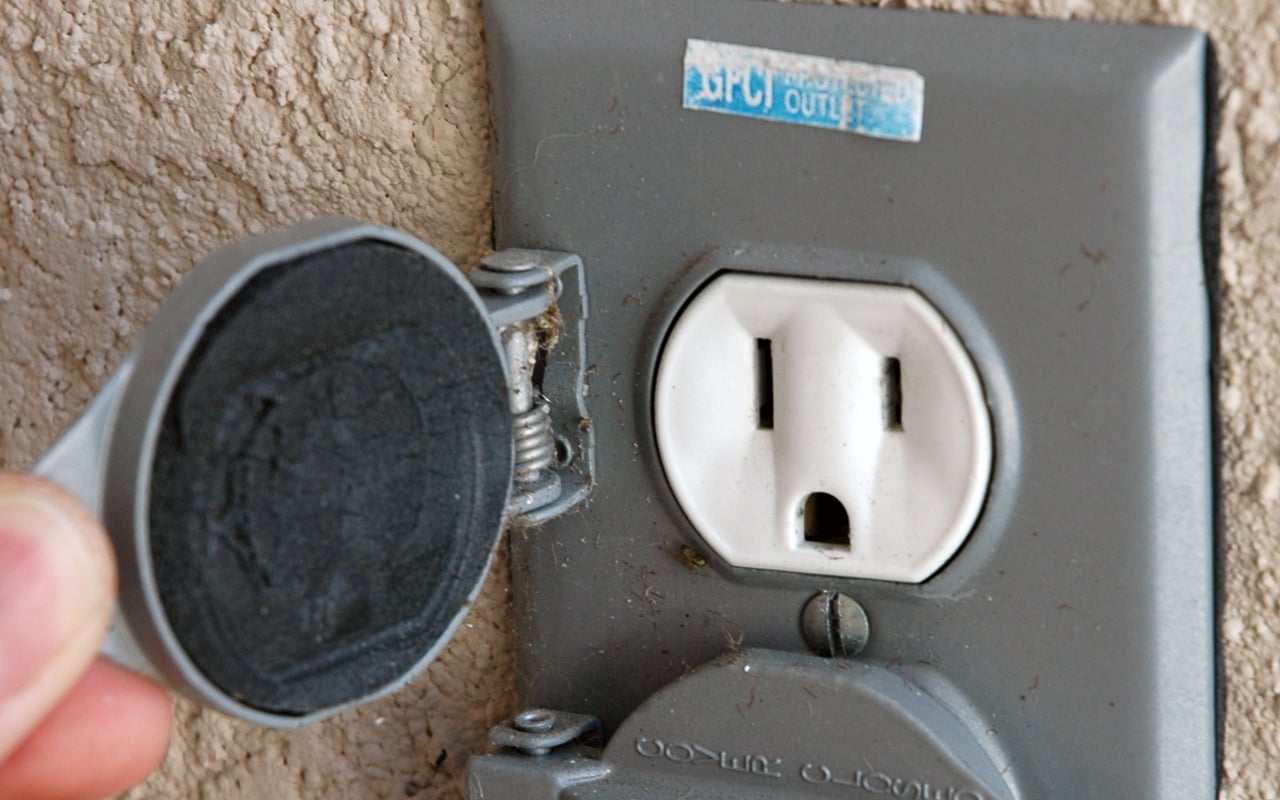
You’ve seen these - the little flip-down lid that covers the outlet when nothing’s plugged in. These are technically called weatherproof while not in use covers. They keep the outlet dry when it’s idle.
The problem? The second you plug something in, the lid flops open, and the outlet is completely exposed. Rain, sprinklers, dew - it all gets in.
For outdoor outlets, this type of cover is no longer code-compliant for most applications. The NEC says any receptacle in a wet location needs an enclosure that’s weatherproof whether or not a cord is plugged in.
Enter the bubble cover.
In-Use (Bubble) Covers
An in-use weather cover - often called a bubble cover - is a domed enclosure that fits over the outlet and accommodates a plugged-in cord. You can leave your extension cord, holiday lights, or landscape lighting plugged in, close the lid, and the connection stays dry.
This is what the NEC requires for all outdoor outlets in wet locations. If your outdoor outlet has a flat lid that won’t close over a plugged-in cord, it needs to be upgraded.
In-use covers come in a few styles:
- Horizontal bubble covers - the lid swings to the side. Best for outlets mounted horizontally or when you need clearance for bulky plugs.
- Vertical bubble covers - the lid swings up or down. Common for standard vertical outlet installations.
- Extra-duty covers - heavy-duty metal or UV-resistant plastic housings for high-traffic areas or direct sun exposure.
- Receptacle box covers - full enclosures that house the entire outlet box, often used for new construction.
Damp Locations vs. Wet Locations
This distinction matters for choosing the right cover. The NEC defines:
- Damp location - partially protected from moisture. Think under a roof overhang or a covered porch that’s open on the sides. Rain doesn’t hit it directly, but humidity and condensation can.
- Wet location - exposed to direct rain, sprinklers, or standing water. Most outdoor outlets fall here.
For damp locations, a standard weatherproof cover (the flat flip-down kind) is still acceptable as long as nothing’s plugged in. For wet locations - and most outdoor outlets are wet locations - you need the in-use bubble cover that works whether a cord’s plugged in or not.
If you’re not sure which category your outlet falls into, go with the in-use cover. It’s safer and covers both scenarios.
How to Check Your Existing Outdoor Outlets
Before you start buying parts, take a walk around your house and do a quick inspection. Here’s what to look for.
Step 1: Can you find all your outdoor outlets? Walk the perimeter. Check the front and back, both sides of the house, the garage, the deck or patio, and any outdoor structures like a shed or workshop. Code requires at least one outdoor outlet in the front and one in the back of a house, plus one on each porch or balcony.
Step 2: Do they have GFCI protection? Look for the TEST and RESET buttons on the face of the outlet. If you don’t see them, the outlet might be downstream of a GFCI earlier in the circuit - or it might not have GFCI protection at all. Press TEST to confirm the outlet kills power (use a plug-in nightlight or outlet tester). If it doesn’t trip, you need an upgrade. If the outlet is dead instead of tripping, use the safe sequence in Dead Outlet: Safe Checks Before Calling before you assume the device itself failed.
Step 3: Check the cover type. If the cover is a flat lid that can’t close with a cord plugged in, it’s not compliant for a wet location. You need an in-use bubble cover.
Step 4: Look for the WR marking. On the face of the outlet, between the two receptacles, you should see “WR.” If it’s not there, the outlet is not weather-resistant.
Step 5: Check for obvious damage. Cracked face, rust, corrosion, loose mounting, water stains inside the cover - any of these means it’s time for a replacement.
Can You Replace an Outdoor Outlet Yourself?
Here’s the honest answer: if you’re comfortable with basic electrical work and the replacement is straightforward - same wiring, same location, surface-mount box - a competent DIYer can swap an outdoor outlet. But there are some important caveats.
You need to:
- Turn off the power at the breaker and verify it’s off with a non-contact voltage tester
- Use a WR-rated GFCI outlet - don’t use a standard indoor outlet
- Install the correct weather cover - an in-use bubble cover for wet locations
- Seal the box properly - outdoor boxes need to be watertight. Check the gaskets and make sure the screws are snug
- Follow the torque specifications - over-tightening can crack the housing
If any of that sounds outside your comfort zone, call an electrician. A licensed pro can do the swap in under an hour, and the peace of mind is worth the service call. For a broader line between safe homeowner checks and jobs that should stay with a pro, read What Not to DIY With Home Electrical Work.
When You Should Absolutely Call a Pro
Some situations aren’t DIY-friendly. Call an electrician if:
- You don’t have a GFCI outlet at the outdoor location and need to add one
- The wiring is older (pre-1970s, or cloth-insulated wiring)
- There’s no junction box - just wires coming through the siding
- The outlet is frequently tripping or shows signs of water damage
- You need to add a new outlet where one doesn’t exist
- The existing box is rusted or damaged and needs replacement
Common Mistakes Homeowners Make
I’ve seen these over and over. Let’s save you the trouble.
Using a standard indoor cover outside. That flat little plastic lid might keep the outlet dry when idle, but it offers zero protection once you plug something in. It’s a code violation and a safety hazard.
Skipping the WR rating. A regular GFCI receptacle costs less, and it might work fine for a while. But the internal components will corrode faster outdoors, especially in humid climates or near the coast. WR outlets are built to last.
Forgetting about the gasket. The weather cover needs a foam or rubber gasket to seal against the box. If the gasket is missing, cracked, or compressed flat, replace it. A $2 gasket is cheap insurance.
Using the wrong box. Not all electrical boxes are rated for outdoor use. You need a box that’s listed for wet locations. Plastic or die-cast metal outdoor boxes are common and inexpensive - just make sure the box itself is labeled for outdoor use.
Leaving cords plugged in permanently. Even with an in-use cover, you shouldn’t leave extension cords connected for months on end. Cords degrade in sunlight, and the constant pressure against the cover gasket can lead to leaks over time. Unplug seasonal decorations when they’re not in use.
The Cost of Upgrading
If you need to replace a single outdoor outlet with a WR GFCI and an in-use cover, here’s what you’re looking at:
- WR GFCI receptacle: $15-$25
- In-use weather cover: $8-$20 (plastic), $15-$35 (metal)
- Outdoor-rated junction box: $5-$15 (if needed)
- Gasket and miscellaneous: $2-$5
- Electrician labor for swap: $100-$200 (typical service call)
Total DIY: around $25-$50 per outlet. Professional install: $125-$250 per outlet depending on your area and the complexity.
Compared to the cost of water damage, electrical fire, or injury - that’s cheap.
Keeping Outdoor Outlets Safe Long-Term
Once your outlets are up to code, maintenance is minimal but not zero.
- Wipe down the cover occasionally - dirt and debris can prevent the gasket from sealing
- Test the GFCI monthly - press the TEST button. The outlet should click and kill power. Press RESET to restore it. If it doesn’t trip, replace the outlet
- Inspect the gasket annually - check for cracking, compression, or gaps
- Trim back landscaping - keep bushes, grass, and mulch away from outdoor outlets to reduce moisture exposure
- Replace covers that have UV damage - plastic covers get brittle after years in direct sun
Related electrical safety guides
If this article helped you check an outdoor receptacle, these nearby guides cover the issues that usually show up next:
- Electrical Outlet Not Working: Troubleshooting: safe first checks before you replace a device.
- Warm Outlet or Switch: When to Worry: when heat at a device is normal and when it is a warning sign.
- What a Frequently Tripping Breaker Is Telling You: how breaker trips differ from GFCI trips.
- When Electrical Work Needs a Permit: when outlet work can trigger permit or inspection questions.
- How to Compare Electrical Estimates: what to look for when you call a pro for outdoor electrical work.
- Two-Prong Outlets in Older Homes: related grounding issues in older houses.
- Aluminum Wiring: What Homeowners Should Know: why older branch circuits deserve extra caution.
- Whole-Home Surge Protection Explained: another panel-level protection upgrade homeowners often ask about.
Quick Answers
Q: Does every outdoor outlet need a weather cover?
Yes. The NEC requires all outdoor receptacles to have a weatherproof cover. If the outlet is in a wet location (most outdoor outlets are), you need an in-use cover that protects the connection even while something’s plugged in. A standard flat cover only works for damp locations where the outlet is protected from direct rain.
Q: Can I use a regular GFCI outlet outside?
No - not anymore. The NEC has required Weather-Resistant (WR) GFCI receptacles for outdoor installation since 2008. A WR outlet has corrosion-resistant internal components that hold up better to moisture, temperature changes, and UV exposure. Standard GFCI outlets will fail faster outdoors.
Q: How do I know if my outdoor outlet is GFCI protected?
Look for the TEST and RESET buttons on the face of the outlet. Those are the hallmark of a GFCI receptacle. If you don’t see buttons, the outlet may be protected by a GFCI breaker in your panel, or it may not have GFCI protection at all. Push the TEST button to confirm - a working GFCI will kill power to the outlet and anything downstream. If the power stays on, you don’t have GFCI protection.
Q: What’s the difference between a bubble cover and a flat cover?
A flat cover (standard weatherproof cover) flips down to cover the outlet when nothing’s plugged in. It’s fine for damp locations. An in-use cover (bubble cover) is deep enough to close over a plugged-in cord, keeping the connection dry. The NEC requires in-use covers for all outdoor outlets in wet locations - which is almost everything outside that isn’t under a solid roof.
Q: Can I install an outdoor outlet myself?
If you’re swapping an existing outlet with a WR GFCI and an in-use cover on the same wiring and box, it’s within reach for a confident DIYer who knows how to work safely with electricity. Turn off the breaker, verify power is dead with a tester, and follow the manufacturer’s instructions. But adding a new outlet, upgrading the box, or dealing with older wiring are jobs best left to a licensed electrician.
Q: Why does my outdoor outlet keep tripping the GFCI?
Frequent tripping usually means moisture is getting into the outlet or the connected cord. Check the weather cover gasket, make sure the cover closes fully, inspect the cord for damage, and verify the outlet itself isn’t corroded. In some cases, the GFCI has simply aged out - they don’t last forever, especially outdoors. If replacing the outlet doesn’t fix it, the issue may be in the wiring, and you’ll need an electrician to investigate. For nuisance trips away from outdoor receptacles, GFCI Outlet Keeps Tripping: Causes and Fixes walks through the next checks.
Q: Do outdoor outlets need to be on their own circuit?
No. Outdoor outlets can share a circuit with other outlets or lighting in the same area. The code requires them to have GFCI protection, but there’s no requirement for a dedicated circuit - unless you’re installing multiple high-draw items like pool pumps or outdoor kitchens. Those are separate stories.