Why Your GFCI Outlet Keeps Tripping and How to Fix It
Learn why a GFCI outlet keeps tripping, how to test appliances and moisture safely, and when repeat trips point to wiring that needs a licensed electrician.
Articles on this site may include sponsored content. If they do, it's labeled clearly - and it still has to answer a real homeowner question. Same bar as everything else here.
GFCI Outlet Keeps Tripping: Causes and Fixes
I get at least one call a week from a homeowner ready to tear a GFCI outlet off the wall. It keeps popping - the bathroom one, the garage one, the kitchen sink - and always at the worst possible moment. The hair dryer dies mid-blowout. The garage fridge goes quiet and you don’t notice until the door opens three days later.
Here’s what I tell every single one of them: that outlet is not your enemy. It’s doing exactly what it was designed to do. The question is why it keeps deciding it needs to.
This guide covers the causes, the fixes, and the one thing most homeowners get wrong about GFCI outlets. This isn’t a DIY wiring tutorial - it’s a practical, safety-first playbook for figuring out what’s actually going on before you spend money you might not need to.
How a GFCI actually works (in 30 seconds)
A standard outlet compares the current going out on the hot wire to the current coming back on the neutral. If they don’t match - if even a tiny fraction is leaking somewhere it shouldn’t - the GFCI trips in a fraction of a second.
How tiny? A GFCI trips when it detects a ground fault as small as 4 to 6 milliamps. That’s less current than a single LED nightlight draws. The device is sensitive by design, and that sensitivity is what has made GFCI protection one of the most effective electrical safety inventions in the last 50 years.
The important distinction: a GFCI does not protect against overloads or short circuits. That’s what your breaker does. A GFCI protects against electrocution. If it keeps tripping, something is leaking current to ground. If the breaker is tripping too, use our guide to what a frequently tripping breaker is telling you before treating this as only a GFCI problem.
The short list of what causes a GFCI to trip
Every GFCI trip falls into one of these categories. If you know which one you’re dealing with, you’re most of the way to a fix.
1. Moisture
This is the most common cause, especially in spring and summer. Humidity, rain, condensation, a leaking pipe - any moisture inside the outlet box can create a path for current to leak to ground.
Outdoor outlets are the usual suspects, but I’ve found moisture in bathroom outlets behind vanities, garage outlets near open doors, and basement outlets on concrete walls that sweat in humid weather. The fix is to dry the box thoroughly, reseal gaps around the weather cover, and make sure the “while-in-use” cover is actually closing properly.
2. A faulty appliance
Appliances with motors, heating elements, or compressors are the most likely to develop the kind of internal leakage that triggers a GFCI. Refrigerators, freezers, washing machines, dishwashers, and even the pump in a coffee machine can all develop ground faults as they age. If the same appliance keeps being involved, the dedicated circuits for appliances guide explains when a separate run is worth discussing.
The test is straightforward: unplug everything from the GFCI and everything downstream of it, press RESET, and see if it holds. If it does, plug devices back in one at a time. The one that causes the trip is the problem. If the appliance is old, the fix is almost always replacement.
3. A downstream ground fault
A single GFCI can protect multiple standard outlets downstream via the LOAD terminals. That means the outlet that keeps tripping may be fine - the fault is on a different outlet in a different room.
I’ve seen a master bathroom GFCI trip because a guest bathroom outlet on the same circuit had a loose ground wire brushing a neutral screw. And a garage GFCI trip because a backyard outlet three rooms away had water in the box after a storm.
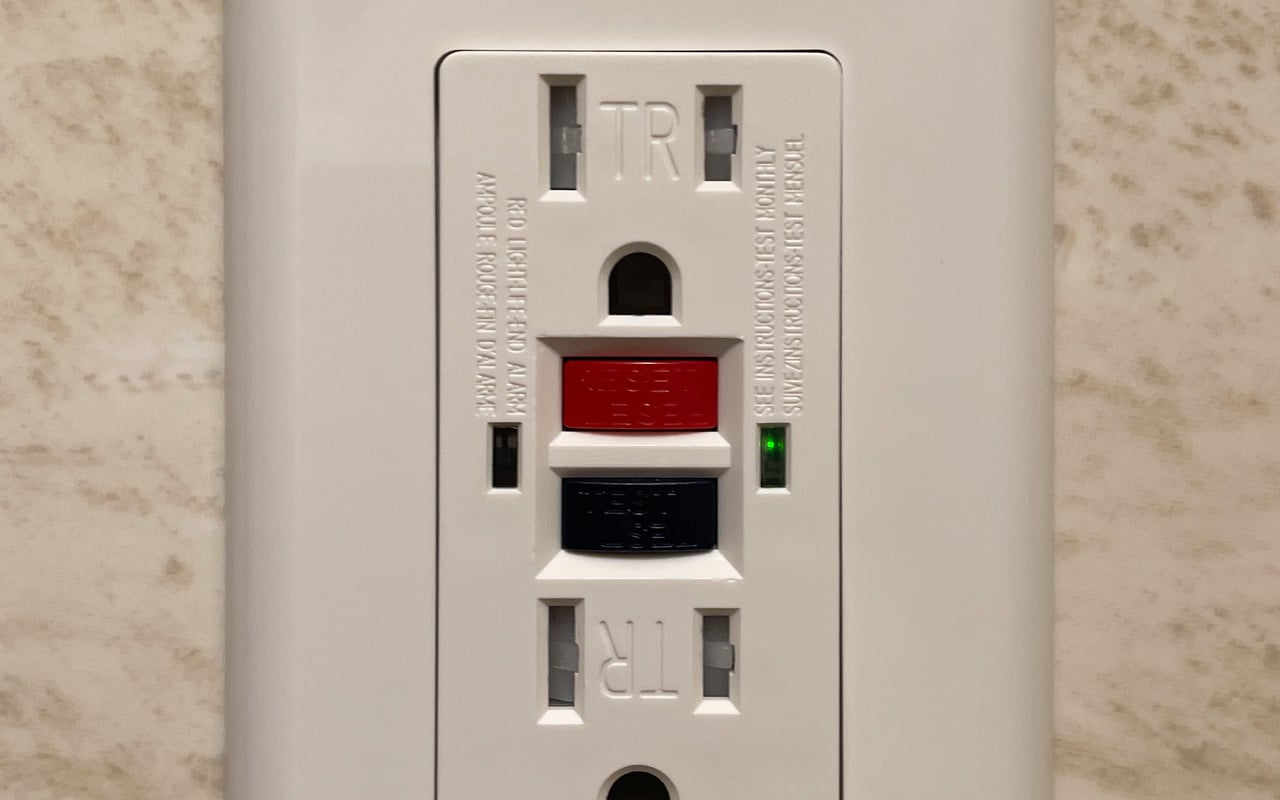
How to check: press TEST and RESET on every GFCI in the house. If pressing TEST on one kills power to another outlet, they’re connected via LOAD, and the downstream one needs inspection.
4. Loose or damaged wiring
A loose connection at the GFCI itself or at a downstream outlet can cause intermittent tripping. The most common offender is a bare copper ground wire sitting close enough to a neutral terminal screw to conduct intermittently when the outlet warms up or gets bumped.
This is also where rodent damage shows up. Mice and squirrels chew through Romex sheathing, and the exposed wires can create enough leakage to trip a GFCI unpredictably.
5. An old or defective GFCI
GFCI outlets have a finite service life. The internal electronics degrade over time. I start seeing failures in the 10- to 15-year range, and 20-year-old units should be replaced on principle.
Signs of a failing GFCI: it won’t reset even with nothing plugged in, the TEST button doesn’t pop out when pressed, the outlet feels warm, or there’s visible discoloration on the face. A warm or marked-up device deserves the same caution as any warm outlet or switch: stop using it until the cause is clear.
6. Multiple GFCIs on the same circuit wired incorrectly
If more than one GFCI is on the same circuit and one feeds the other through its LOAD terminals, you can get nuisance tripping. The fix: only one GFCI should protect any given section of a circuit. Either wire all downstream GFCIs only to the LINE side, or use a single GFCI at the first outlet and standard outlets downstream.
7. Power surges and lightning
A voltage spike from a lightning strike or grid switching can damage the sensitive electronics inside a GFCI. If a GFCI starts tripping repeatedly after a storm, the device is likely damaged. Replace it.
Step-by-step troubleshooting
Do not open any electrical boxes or touch wires if you are not comfortable working with electricity. These steps are limited to what you can safely do from the outside.
- Unplug everything from the tripping GFCI and from every outlet that loses power when it trips.
- Press RESET firmly. If it clicks and stays in, you’re in good shape. If the button won’t stay in or pops back out, you have a hard fault.
- Turn off the breaker that feeds the GFCI. Wait 10 minutes. Turn it back on and try RESET again. This clears the internal electronics and sometimes fixes a nuisance trip from a minor transient.
- If it resets and holds, plug devices back in one at a time. The one that triggers the trip is your culprit.
- If it still trips with nothing plugged in, the problem is in the wiring or the device itself. Check outdoor outlets for moisture if it has rained recently.
- Test the GFCI itself. Press TEST. The RESET button should pop out. If it doesn’t, the device has failed and needs replacement.
- When in doubt, isolate. If you suspect a downstream fault, the cleanest test is to disconnect the LOAD wires from the GFCI (breaker off, voltage tester confirming dead). If the GFCI resets and holds with no load, the problem is downstream.
When to call a pro
You do not need an electrician to press RESET or to unplug and test appliances one at a time. Call one for:
- Any troubleshooting that requires opening a box you’re not comfortable working in
- A GFCI that trips immediately on reset even with all downstream loads disconnected
- Outlets with signs of burning, melting, or discoloration
- Trips accompanied by a burning smell or buzzing sound
- Aluminum wiring - if your home was built between 1965 and 1972, GFCI connections need special handling
- Repeated tripping you cannot isolate to a specific appliance
A typical service call to diagnose a GFCI issue runs $150 to $300 depending on your area. If the fix is replacing the GFCI itself, expect $200 to $400 with parts and labor. Tracing a hidden wiring fault will cost more.
DIY replacement: when it makes sense
Replacing a GFCI outlet is within reach of a competent DIYer if you understand the line/load labels and the limits covered in what not to DIY with home electrical work. It makes sense only if:
- You have confirmed the problem is the GFCI itself (fails TEST/RESET, is old, or trips with all loads disconnected and nothing downstream)
- The replacement is a straightforward swap - same location, same wiring configuration
- You are comfortable turning off the breaker, verifying the circuit is dead with a non-contact voltage tester, and making secure connections
Pay attention to LINE vs. LOAD labeling on the new GFCI. Getting them reversed is the single most common DIY mistake. LINE is the feed from the panel. LOAD protects anything downstream. If you swap them, the GFCI won’t trip when you press TEST, and it won’t provide protection.
FAQ
Why does my GFCI keep tripping with nothing plugged in?
The most likely causes are moisture inside the outlet box, a loose wire touching the metal box or another terminal, a failed GFCI device, or a ground fault on a downstream outlet that’s protected by this GFCI. If you’ve unplugged everything and the GFCI still won’t hold, the problem is in the wiring or the device itself - not in any appliance. Check outdoor outlets for water intrusion, especially after rain.
How long do GFCI outlets last?
Typically 10 to 15 years in normal conditions. Outdoor and garage units exposed to moisture, temperature swings, and power surges may fail sooner. NEC recommends testing monthly. If a GFCI fails the TEST button (doesn’t pop out when pressed), replace it immediately - it is no longer providing protection even if it still passes power.
Can a refrigerator be on a GFCI?
Yes, but refrigerators are one of the most common sources of nuisance GFCI trips - the compressor motor can develop ground faults as it ages, and defrost cycle heating elements can leak small amounts of current. Many electricians install a dedicated, labeled GFCI for the refrigerator so a trip doesn’t affect other outlets. If your fridge keeps tripping the GFCI, the appliance itself may need service.
How do I find which outlet is causing my GFCI to trip?
Unplug everything from the GFCI and from every outlet that loses power when it trips. Press RESET. If it holds, plug devices back in one at a time - the device that causes the trip is the problem. If it still trips with everything unplugged, the issue is in the wiring, moisture, or the GFCI itself.
My GFCI trips when it rains. What’s wrong?
Water is getting into an outlet box or a weather cover that isn’t sealing properly. Check all outdoor outlets on the circuit, including ones hidden behind bushes, under decks, or near AC units. The weather cover may need to be replaced with a “while-in-use” type that seals even when a cord is plugged in. If the outlet itself shows signs of corrosion or rust, replace it with a WR (Weather Resistant) rated GFCI. Also check outdoor lights, receptacles in crawl spaces, and any exterior junction boxes.
What’s the difference between a GFCI tripping and a breaker tripping?
A GFCI trips when it detects a ground fault - current leaking to ground through an unintended path like water or a person. It protects against shock. A standard breaker trips when it detects an overload (too much current) or a short circuit (hot wire touching neutral or ground). It protects against fire. If your outlet trips but the breaker doesn’t, it’s a ground fault. If both trip, you may have a more serious wiring fault.
Is it safe to replace a GFCI with a standard outlet?
No. Code requires GFCI protection in bathrooms, kitchens, garages, unfinished basements, outdoors, crawl spaces, laundry rooms, and within 6 feet of any sink. Replacing a GFCI with a standard outlet removes that protection and violates NEC Section 210.8. If a GFCI fails and you’re not comfortable replacing it, call an electrician. Do not bypass the protection.
Related reading
- GFCI and AFCI Protection Without the Alphabet Soup - A broader look at protection devices and where they’re required
- Dead Outlet: Safe Checks Before Calling - What to check when an outlet stops working entirely
- What a Frequently Tripping Breaker Is Telling You - Breaker trips versus GFCI trips and what they each mean
- Outdoor Outlet Safety and Weather Covers - Protecting outlets exposed to the elements
Bottom line
A GFCI outlet that keeps tripping is telling you something. Nine times out of ten, it’s moisture, a failing appliance, a wiring issue on a downstream outlet, or a GFCI that has simply reached the end of its useful life. Start by unplugging everything, isolate the cause, and replace the device if it fails its test. If the trip pattern is random, intermittent, or tied to weather, suspect moisture or an aging unit.
Don’t curse the outlet. It’s doing its job. Figure out what it’s telling you, and the fix is usually simpler than you think.