Flickering Lights: Bulb, Fixture, Circuit, or Utility?
Flickering lights decoded - bulb, fixture, circuit, or utility. A plain-English guide to what causes the flicker, what to check safely, and when to call a pro.
Articles on this site may include sponsored content. If they do, it's labeled clearly - and it still has to answer a real homeowner question. Same bar as everything else here.
Flickering Lights: Bulb, Fixture, Circuit, or Utility?
TL;DR: Flickering lights aren’t always an emergency, but they’re never nothing. A bulb flickers when power fluctuates or the connection is loose - the question is where that fluctuation or looseness lives. If the flicker follows a single bulb, it’s the bulb or fixture. If it spans a whole room or the whole house, the problem is in your panel or on the utility line. Start with the easy checks (tighten the bulb, swap it), move to the panel (loose breakers, flicker patterns), and call your utility if the whole house is blinking. You want a frame of reference, not a panic button.
Every time I walk into a house with flickering lights, the homeowner greets me with the same look - somewhere between annoyed and genuinely worried. And they should be a little worried. Flickering lights can be a loose ninety-nine-cent bulb, or they can be a connection burning loose inside your panel, which is the opposite of a minor problem.
Here’s the thing: your lights are the nervous system of your house. When they flicker, your electrical system is trying to tell you something. The trick is learning to translate - and it’s not as hard as you think.
The three-question diagnosis
I tell homeowners to ask themselves three questions before they even pick up the phone. Write down the answers. They’ll save you time, money, and at least one unnecessary service call fee.
1. Where does the flicker happen?
Grab a notepad - or just your phone’s notes app. Walk through every room. If you are not sure which rooms share a circuit, start with how to read an electrical panel label. Is it:
- One single light fixture? Good news - the problem is almost certainly that fixture or its bulb.
- Multiple lights in the same room? You might be looking at a loose wire in that room’s switch box or a circuit that’s about to max out.
- Lights in multiple rooms on the same side of the house? That suggests a problem in your main panel or at the meter.
- Lights all over the house at the same time? Utility-side problem. Call your power company.
2. When does it happen?
Timing tells you almost as much as location.
- When the AC kicks on? Or the sump pump? Or the microwave? That’s a heavy-load dim, not a flicker. Every motor-driven appliance pulls a surge when it starts. A brief, single dim is normal - your voltage dips for a split second and recovers. What’s not normal is lights staying dim or dimming repeatedly.
- When it’s windy outside? That’s a utility problem. A tree branch touching the service drop or a loose connection on the pole will make itself known when the wind blows.
- Random and unpredictable? Intermittent flickers are the hardest to diagnose because they don’t hang around long enough to measure. But they’re also the ones that most often point to a loose connection somewhere - and loose connections generate heat.
3. Is the flicker fast or slow? Dim or cut out completely?
- A rapid, strobing flicker (think a bad fluorescent tube or an LED on a dimmer it hates) is almost always the bulb or the fixture.
- A slow, rhythmic dim - like someone’s turning a dimmer switch up and down in slow motion - suggests a big load cycling on and off. Electric water heaters, well pumps, and heat pumps all do this.
- A complete blackout that lasts a fraction of a second and comes back - that’s a loose connection. And loose connections are where electrical fires start.
Start with the easy stuff
You can eliminate 70% of flickering light calls without touching a wire. Seriously. Try these in order.
1. Tighten the bulb
I know. It sounds patronizing. But you’d be amazed how many service calls I’ve rolled on where the bulb just needed a quarter-turn. Screw it in firmly - not gorilla-grip, just snug.
2. Swap the bulb with one you know works
If the flicker follows the bulb to a different socket, congratulations - you need a new bulb, not an electrician. If it stays in the same socket, the fixture is the problem.
3. Check the dimmer switch
If you have a dimmer controlling an LED bulb, this is your most likely culprit. Not all LEDs are dimmable, and not all dimmers work with all LEDs. The mismatch causes a flicker that looks like an electrical gremlin but is actually just incompatibility. Check the compatibility list on the dimmer packaging or online. If the dimmer was installed before 2015, there’s a very good chance it’s designed for incandescent bulbs, and that’s your problem. For a deeper look at that specific pattern, read the guide to dimmer switch compatibility.
4. Look at the switch
A dimmer that feels warm to the touch is a dimmer under stress. A standard toggle switch that wiggles in its box has loose mounting screws. Neither of these is a fire yet, but both are a sign that something is working harder than it should be.
When the fixture itself is the problem
If you’ve swapped the bulb, checked the dimmer, and the lights are still dancing, it’s time to look at the fixture. I’ll be honest: this is the point where most homeowners should stop and call a licensed electrician. Opening a ceiling fixture involves exposed wires, and if you don’t know which screw is hot and which is neutral, you’re gambling.
That said, here’s what an electrician would check:
Loose wire connections in the box
Inside every ceiling fixture is a junction box with wire nuts connecting the house wiring to the fixture. A wire nut that wasn’t twisted on tight enough fifteen years ago will loosen over time as the fixture heats and cools. That loose connection creates resistance, resistance creates heat, and heat causes the connection to loosen further. It’s a feedback loop that ends badly if left alone.
Bad sockets
In older fixtures, the center tab inside the light socket can get compressed over years of bulb changes, losing contact with the bulb’s bottom. An electrician can gently pry it back up with a non-conductive tool - but again, this is not a DIY job if you’re not confident.
Fixture aging out
Some fixtures just die. The internal wiring degrades, the socket corrodes, the whole thing starts acting flaky. If the fixture is more than twenty years old and you’re chasing issues, it’s probably time to retire it. And honestly? A new fixture costs less than a service call to fix the old one most of the time.
Circuit-level problems
If multiple lights in the same room are flickering - or lights plus outlets are acting up - the problem has graduated from the fixture level to the circuit level.
Overloaded circuits
Every circuit in your panel has a maximum load, measured in amps. A 15-amp circuit, for example, can safely handle about 1,800 watts. When you push more than that - say, running a space heater, a vacuum, and a window AC on the same circuit - the voltage drops. Lights that share that circuit will flicker or dim.
The fix is to redistribute loads. Move the space heater to a different circuit. Don’t run the microwave and the toaster oven at the same time on the same kitchen circuit. If you can’t solve it by rearranging plug-in devices, the circuit may need to be split - that’s an electrician job. If the same circuit is also shutting off, compare the pattern with what a frequently tripping breaker is telling you and dedicated circuits for appliances.
Loose connections at the breaker
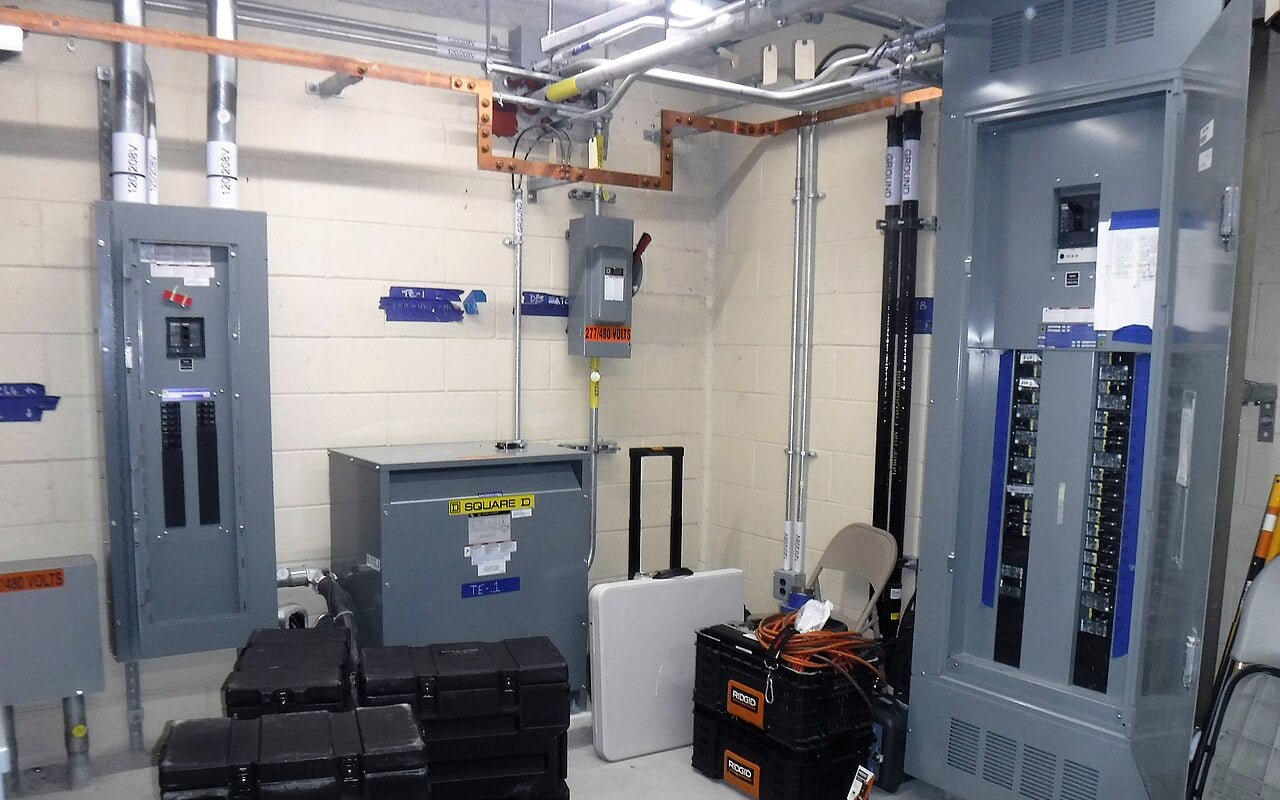
A breaker that isn’t fully seated in the panel, or one with a loose terminal screw, will cause intermittent flickering on everything that breaker feeds. This is one of those things that sounds scary - and it is - but it’s also a straightforward fix for a pro. I’ve opened panels where the main breaker was barely finger-tight on the bus bar, and the homeowner had been dealing with flickering lights for two years thinking it was normal. If the panel is old or undersized, the cost context in electrical panel replacement cost helps frame the next conversation.
Shared neutrals
In older wiring, it’s common to find two circuits sharing a neutral wire. That was allowed under older codes, but it creates a problem: when both circuits are loaded, the shared neutral can’t handle the return current, and the voltage goes unstable. This shows up as flickering that changes intensity depending on what appliances are running in two different rooms. The fix - separating the neutrals - requires panel work, and the safety logic overlaps with GFCI and AFCI protection.
Utility-side problems
Here’s your shortcut: if every light in the house flickers at the same time, in the same rhythm, almost always - it is not your problem. It’s the utility company’s problem.
What causes utility-side flicker
- Loose connection at the meter or weatherhead - the big overhead line where power enters your house
- Tree branches touching the service drop - the wire from the pole to your house
- A problem on the transformer serving your neighborhood
- Grid switching - the utility rerouting power after a fault elsewhere, which causes a brief voltage sag
What to do about it
Call your power company. Not an electrician. Most utilities will send someone to check their side - from the meter back to the pole - for free. If they tell you the problem is on your side (past the meter), then call an electrician.
But here’s the angle most homeowners miss: if the utility says it’s your problem but you’re seeing flickers in every room, get a second opinion from an electrician before you start spending. I’ve seen utilities blame homeowners for problems that were clearly on the utility side, and it took a licensed electrician’s written report to get them to fix it.
When it’s an emergency
Most flickering lights are not emergencies. But some are. Here’s when you should drop everything and call someone now.
- Flickering plus a burning smell. That’s a wire heating up. Turn off the breaker for that circuit, and call an electrician immediately.
- Flickering plus buzzing from the panel. Your panel or a breaker inside it is failing. The sound guide, buzzing electrical sounds: what they can mean, explains which noises deserve an immediate call.
- Flickering plus warm outlets or switch plates. Heat equals resistance, resistance equals fire risk. Use warm outlet or switch: when to worry to separate normal dimmer warmth from a real hazard.
- Flickering that gets worse over a few days. A loose connection that’s progressing will eventually fail completely - and it might arc when it does.
The one tool every homeowner should own
If you want to level up your troubleshooting without becoming an electrician, buy a non-contact voltage tester. They cost fifteen to thirty bucks at any hardware store. It’s a little pen-shaped device that beeps or lights up when it detects voltage near a wire or outlet.
Here’s how you use it for flickering lights: when a light is flickering, pull the switch plate and touch the tester to the wire screws on the side of the switch. If the tester’s behavior changes - beeping intermittently instead of steadily - that switch has a loose connection, and you know exactly where the problem lives. You still shouldn’t fix it yourself if you’re not comfortable, but now you can tell the electrician “switch in the hallway, left screw, intermittent continuity,” and they’ll know exactly what to bring and how long it’ll take. That saves you money.
Can you fix it yourself?
Here’s my honest opinion. Swap a bulb? Yes. Tighten it? Yes. Check a dimmer compatibility list online? Absolutely.
Open a switch box and start poking around with screwdrivers? That depends on your comfort level. If you’re the kind of person who can wire a plug without looking at a diagram, go for it - but turn the breaker off first, verify it’s dead with a tester, and don’t rush. If the idea of touching electrical wires makes your palms sweat, that’s your gut telling you to call a professional. Listen to it, and use what not to DIY with home electrical work as the boundary line.
Electricians don’t judge you for not knowing. We judge you for pretending to know and making things worse. I’ve spent more time fixing DIY “fixes” than I’ve spent fixing original problems.
Quick Answers
Q: Can a loose neutral wire cause lights to flicker?
Yes. A loose neutral is one of the most common causes of flickering lights - and one of the most dangerous. When the neutral connection is loose, the voltage on that circuit becomes unstable. Lights can flicker, dim, or brighten unpredictably. A loose neutral at the panel can affect multiple circuits at once. This isn’t a DIY fix. If you suspect a loose neutral, call an electrician. Loose neutrals create arcing, heat buildup, and fire risk.
Q: Why do my LED lights flicker on a dimmer switch?
Most likely, the dimmer switch and the LED bulb are incompatible. Older dimmers were designed for incandescent bulbs, which have a much higher minimum load. LEDs draw very little power, so an incompatible dimmer can’t regulate them properly - causing flicker at low settings or throughout the range. The fix is either replacing the dimmer with an LED-compatible model or switching to bulbs listed on the dimmer’s compatibility chart. A lot of homeowners assume they need expensive electrical work when the fix is a $20 dimmer swap.
Q: Should I worry about lights that flicker when the AC turns on?
A brief, single dim when a large motor (AC, well pump, sump pump) kicks on is normal. The motor draws a surge of current for a fraction of a second, and the voltage across your whole house dips slightly. If the lights stay dim, or if the AC causes flickering throughout its entire run cycle, you may have an undersized panel, a failing capacitor on the AC unit, or a loose connection. If it’s just a single blink on startup, don’t lose sleep over it.
Q: Can a bad breaker cause flickering lights?
Yes. A breaker with a loose terminal connection or internal damage can pass intermittent current to the circuit it controls. This shows up as flickering that affects everything on that breaker - lights, outlets, appliances. The fix is replacing the breaker, which is a straightforward job for an electrician. Circuit breakers degrade over time, and a breaker that’s tripped many times (or been exposed to a surge) is more likely to develop problems.
Q: My lights flicker when it’s windy. What’s that mean?
It means the connection between your house and the utility pole is loose somewhere. Wind causes the overhead service drop to sway, and if there’s a weak connection at the weatherhead (where the wires enter your house), at the meter, or up on the utility pole, the motion makes and breaks contact. This is a utility problem - call your power company, not an electrician. Tell them your service drop moves in the wind and your lights flicker. They’ll send someone to inspect and tighten connections at no charge.
Q: How do I tell if flickering is from the utility vs. my house wiring?
The rule of thumb: if the flicker affects the whole house - every light, every room, at the same time - it’s almost certainly the utility. If it’s confined to one room or one circuit, it’s in your house wiring. A brief, single dim across the whole house when something big turns on is normal. Repetitive flickering across the whole house is not. Call your utility first, because their diagnostic is free. If they clear their side, then call an electrician. If surges or grid events are part of the story, whole-home surge protection is the next thing to understand.