100 Amp vs 200 Amp Panels: Real-World Upgrade Guide
Compare 100 amp vs 200 amp panels for real homes, including load calculations, EV chargers, service conductors, costs, and when an upgrade pays off.
Articles on this site may include sponsored content. If they do, it's labeled clearly - and it still has to answer a real homeowner question. Same bar as everything else here.
100 Amp vs 200 Amp Panels in Real Homes
You already know the textbook answer: 100 amps for smaller homes, 200 amps for anything with modern loads. The real answer is messier. It involves load calculations that don’t always add up the way the codebook suggests, panel conditions that can turn a simple swap into a whole-house rewire, and homeowners who just want to charge their EV yesterday.
I’ve pulled enough panel schedules and swapped enough services to have opinions on this. Here’s what actually matters on the ground.
The short version for the jobsite
100 amp can work if the house has gas heat, gas water heating, gas cooking, no EV charger planned, and square footage under about 1,800. I’ve seen functional 100 amp services on homes built in the ’60s and ’70s that still have headroom.
200 amp is the safe answer for anything with electric heat, central air over 3 tons, a heat pump, EV charging, a hot tub, or a homeowner who says “we might add stuff later.” “Might” usually means “will.”
400 amp starts making sense when you’ve got a main panel feeding a separate shop or ADU, or a serious EV setup.
The rest of this article is about the gray area - the 100 vs. 200 decision that actually takes some thought.
What a load calculation actually tells you
The NEC load calculation (Article 220) is your starting point, not your final answer. I default to the optional method for existing homes because it usually gives a more realistic picture of actual demand.
Here’s the thing: a load calc that lands at 175 amps doesn’t mean you need 200 amps. It means the calculated load exceeds 100 amps. You need to understand what the calc is capturing and what it isn’t.
Things it captures well:
- General lighting and receptacle load (3 VA per sq ft)
- Small-appliance and laundry circuits (1,500 VA each)
- Fixed appliances (water heater, range, dryer, dishwasher, disposal)
- HVAC (largest of heating or AC, not both)
Things it doesn’t capture well:
- EV chargers - added separately at 100% of nameplate, can blow through headroom fast
- Future loads the homeowner hasn’t bought yet
- That your 30-year-old 100 amp panel might already be a Zinsco or Federal Pacific that needs to go regardless
On-the-ground rule: If your calc comes in under 100 amps (optional method), a 100 amp service can work if the panel is in good shape. If it’s 100-120 amps, have an honest conversation with the homeowner about simultaneous loads. If over 120, spec the 200 amp and stop overthinking it.
The conditions that change the math
A clean load calc is table stakes. Here’s what actually tips the decision in real houses:
1. What’s already in the walls
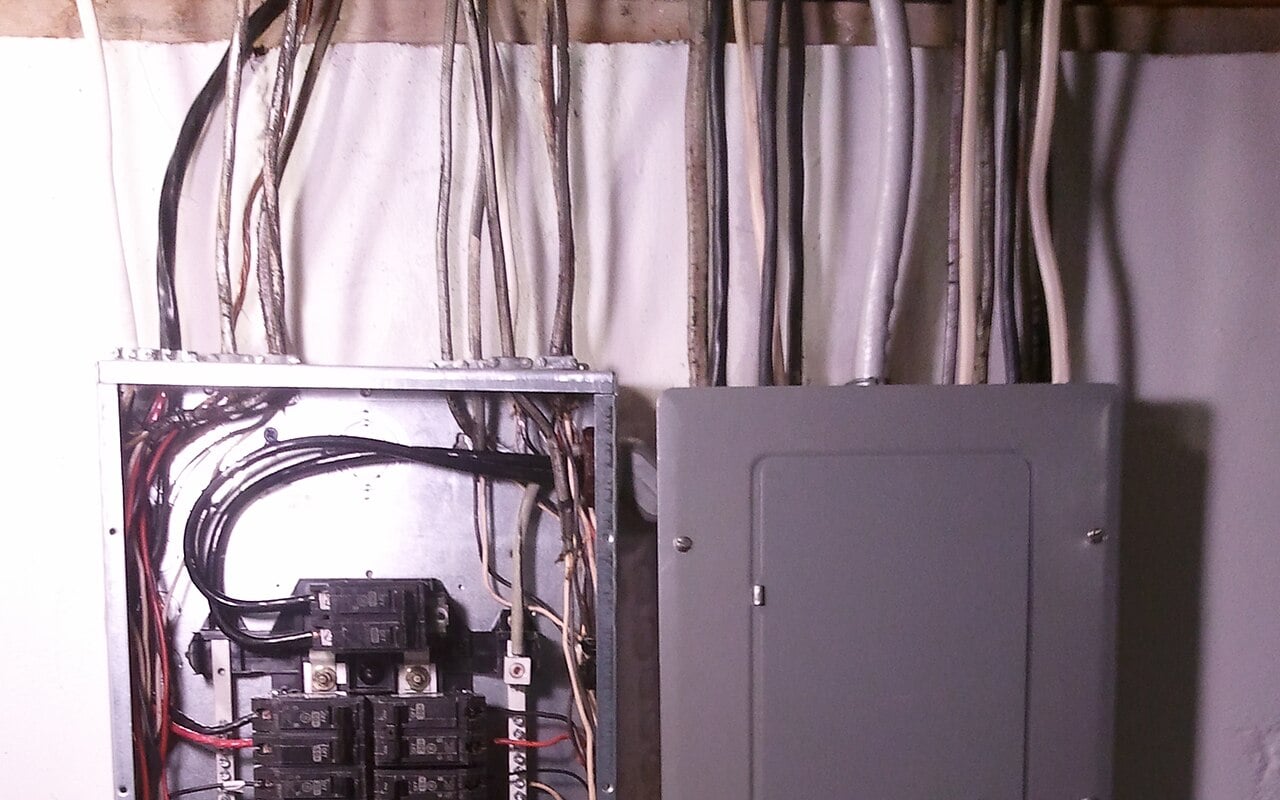
I’ve walked into 1,200 sq ft houses with a 100 amp service that should, on paper, have plenty of capacity. But the existing wiring is aluminum branch circuits from the ’70s, or the panel is stuffed with tandem breakers because the original 12-space box couldn’t handle a modern home.
In these cases, a service upgrade means more than swapping the meter and main breaker. You’re looking at panel replacement, possible feeder upgrade, potential AFCI/GFCI protection requirements you didn’t budget for, and a panel location that made sense in 1965 but is now behind a built-in cabinet.
Don’t quote a 200 amp upgrade until you’ve opened the panel, looked at the feeder size, and verified the conduit or cable path. If the homeowner mainly needs more breaker space, read subpanels explained for homeowners before treating service size as the only fix.
2. The EV elephant in the room
EV charging is the single biggest driver of 100-to-200 amp upgrades right now. A Level 2 charger at 32A continuous (40A breaker) adds 8,000 VA at 100%, with no demand factor. A 48A charger adds 12,000 VA.
Throw that at a 100 amp service running at 70-80 amps calculated load, and you’re over. You can use load management systems (DCC, smart chargers with current monitoring), but these add cost and complexity.
What I tell homeowners: “We can make 100 amps work with load management, but you’ll pay for the equipment and the configuration. A 200 amp service means you plug in and never think about it again.”
Some homeowners want to save on the upgrade. Fine - document the load management solution and move on. But know that when they add a heat pump next year, you’re getting the call. For EV-specific planning, the Level 2 EV charger questions guide helps separate charger size from service capacity.
3. Panel condition and age
A 100 amp panel from 1985 that’s been dry is different from one that’s been in a damp basement with corroded bus bars.
Conditions that force a replacement regardless of ampacity:
- Federal Pacific (FPE) Stab-Lok and Zinsco/Sylvania - these need to go
- Split-bus panels (6-main-rule) - code no longer recognizes them and replacement breakers are hard to find
- Melted bus stabs, corrosion, evidence of arcing
- Discontinued breaker form factors (Thomas & Betts, some older GE types)
If the panel is shot, the 100 vs. 200 conversation changes. You’re replacing it anyway. The difference between a 100A and 200A main breaker loadcenter is usually under $200 at wholesale, and the labor is nearly identical. When you’re already doing a panel swap, upsizing to 200 amps is almost always the right call.
4. Service entrance conductor condition
This is where the budget gets real. Going from 100A to 200A means #2 AL or #4 CU service conductors need to become #4/0 AL or #2/0 CU. Running new service conductors can mean:
- Overhead service: New mast, weatherhead, and riser
- Underground service: Trenching, or pulling through existing conduit if it’s 2” or larger
- Utility coordination: Can add weeks to the timeline, especially when the permit path is not clear. The electrical work permit guide is useful context here
Pro move: Before quoting a 200 amp upgrade, verify the conduit size, conductor size, and type. Nothing derails a job like showing up to trench 50 feet through a finished yard.
The numbers that matter
Real-world material costs (not your final quote):
| Item | 100A | 200A |
|---|---|---|
| Main breaker loadcenter (30-space) | $90-130 | $110-160 |
| Service cable per ft (AL) | $2-3 (#2) | $4-6 (#4/0) |
| Meter socket (200A rated either way) | $40-70 | $40-70 |
The labor is the same either way. The real cost delta is in the service conductors.
Total job ranges I see across markets:
- 100A panel replacement (same ampacity): $1,500-2,500
- 100A to 200A upgrade (new service conductors): $2,500-4,500
- With overhead mast replacement: $3,000-5,500
- With underground trenching: $4,000-8,000
These vary by region. I’ve seen $6,000 upgrades in the Northeast and $2,800 in the Midwest for similar scopes. For a homeowner-facing estimate breakdown, point them to the electrical panel replacement cost guide.
The conversation with the homeowner
Most homeowners don’t know the difference between amps and volts. They know breakers trip or they bought an EV. When bids disagree, the electrical estimate comparison guide helps them compare scope before price. Here’s the framework I use:
“Here’s what 100 amps gives you:”
- Gas heat, gas water, gas cooking, or efficient electric for one at a time
- Standard appliances running normally
- Not much room for growth
- Adding central AC or EV means we’re talking about an upgrade
“Here’s what 200 amps gives you:”
- Electric heat pump, electric water heater, range, oven, dryer, all at once
- EV charging at full speed
- Central AC up to 4 tons
- Future additions without calling me back
- Room for a home office, workshop, or ADU
“Here’s the gotcha:”
- If existing wiring is in bad shape, the upgrade costs more than expected
- Utility work (trench, mast) adds time and cost outside my control
- A 200 amp service doesn’t fix undersized branch circuits
When to say 100 amps is the right answer
Not every house needs 200 amps. I’ve done 100 amp replacements where the load calc is clean, the homeowner is realistic, and there’s no EV or HVAC plan. These are usually:
- Condos and apartments (HMO restrictions)
- Small starter homes under 1,200 sq ft with gas everything
- Vacation cabins that see light use
- Homes where the owner plans to sell within 3 years
In these cases, a straight 100 amp replacement is the most cost-effective option. Just install a panel with enough spaces. A 30-space, 40-circuit panel on a 100A main gives room for the next owner.
When to push for 200 amps
- Any home with electric heat, heat pump, or planned mini-splits
- Homes with an EV or “planning to get one next year,” they always do
- Homes with electric water heaters
- Homes over 2,000 sq ft with central AC
- Homes where the panel is already being replaced and service conductors are being touched
- Any situation where future plans are unclear and the cost delta is small
The last one is the most common. Spend the extra $200 on material now and save the homeowner $3,000-5,000 in five years.
FAQ
What size service do most modern homes need?
Most modern homes built today come with 200 amp service as standard. That covers electric ranges, dryers, water heaters, central HVAC, and room for EV charging. Smaller homes under 1,500 sq ft with gas appliances can still live on 100 amps, but 200 has become the de facto minimum for new construction.
Can a 100 amp panel handle an EV charger?
It can, with caveats. Run a load calculation first. If there’s headroom, a 16-20 amp EV charger on a 20-25A breaker will work alongside moderate household loads. For faster charging (32A or 48A), you almost always need 200 amp service or a load management system that automatically reduces charging power when other large loads are running.
How can I tell if my home has 100 amp or 200 amp service?
Look at the main breaker in your panel, the largest breaker at the top or bottom. The panel label guide shows where that rating usually appears. It should be labeled with its amperage (e.g., “100” or “200”). If you have a main lug panel with a separate disconnect at the meter, check the meter socket rating or the breaker on the disconnect.
What’s the price difference between a 100 amp and 200 amp panel upgrade?
The panel itself costs about $50-100 more for 200 amp at wholesale. The real cost difference comes from the service entrance conductors. Expect a 200A upgrade to cost $1,000-3,000 more than a same-ampacity replacement, depending on the service configuration.
Do I need to upgrade my service to 200 amps if breakers keep tripping?
Not necessarily. If only one breaker trips, it’s a branch circuit issue, not a service issue. If multiple circuits or the main breaker trips regularly, that’s when service capacity becomes the question. Start with why a breaker keeps tripping before committing to a service upgrade.
Can I upgrade from 100 amp to 200 amp without changing the wiring in my house?
Yes, the branch circuits inside your walls stay the same. The upgrade involves the service entrance conductors, meter socket, main panel, and main breaker. Your 15A and 20A branch circuits remain unchanged unless there are unrelated code violations.
Does a 200 amp panel use more electricity than a 100 amp panel?
No. The panel rating is the maximum current it can safely carry, not what it draws. Your actual electricity usage depends on what loads you’re running. A larger panel simply has capacity for more loads running simultaneously. Your energy bill won’t go up just because you installed a bigger panel.
Code and permit notes
Most jurisdictions require a permit for a service upgrade. Key code requirements:
- NEC 230.70 - Service disconnect must be readily accessible
- NEC 230.79 - Rating of service disconnect (min 100A for 1-family dwelling)
- NEC 250.24 - Grounding electrode system must meet current code
- NEC 210.8 & 210.12 - AFCI/GFCI protection for panel circuits (budget for combo breakers)
- Local amendments - Some jurisdictions require exterior disconnects, surge protection, or specific working clearances
Don’t skip the permit. Most utilities won’t reconnect without the inspection green tag.
The bottom line
The 100 amp vs 200 amp decision comes down to three things: load, future plans, and the condition of what’s already there. Run the calc. Look at the panel. Ask the homeowner what they’re planning for the next 10 years. When in doubt, and when the material cost delta is under $500, spec the 200 amp and sleep better.
You’re not doing the homeowner a favor by saving them $300 today if they’re spending $4,000 in three years for the same work. And you’re not doing yourself any favors if the call comes back because the new heat pump and the EV charger can’t coexist on 100 amps.